
Most golfers can tell you their rough driving distance. Very few can tell you their ball speed. And almost none of them know whether that number is good, poor, or simply average for their level. That's a problem, because ball speed is one of the most reliable predictors of carry distance, and the most direct measure of what actually happened at impact. It doesn't care about your handicap, your equipment budget, or how flush it felt.
Ball speed is the data parameter that all golfers are interested in but what is it, what’s a good score and how do you improve it? Find out below.
What is ball Speed?
Ball speed is a measure of how fast the golf ball is going following impact with the club face. The higher the ball speed, the more distance the ball is going to travel, giving the golf player an advantage over their competitors.
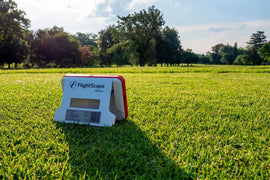
There are a few factors that contribute to a high ball speed such as swing speed and impact quality. This is where the Face Impact Location with the FlightScope X3C and the Pro Package & Face Impact Location with the FlightScope Mevo Gen2 are really helpful, allowing you to measure your impact quality. All of the FlightScope launch monitors measure ball speed
What is a good ball speed Score?
The average male PGA tour golfer will be striking the ball at around 170 mph with some of the faster players such as Byrson DeChambeau striking at an average ball speed of a whopping 191.5 mph in the 2021 season. Interestingly, despite having a higher swing speed, DeChambeau had a marginally lower ball speed than Cameron Champ, thanks to a more efficient swing. Golf purists may turn their nose at this, stating it as a reason to not concentrate on club head speed but instead, focus on swing quality. However, playing devil's advocate, would Bryson DeChambeau have achieved the ball speeds he did had he not focused on increasing club head speed…probably not!
As you go down the levels, ball speeds drop. The average 5 handicap male player will have a ball speed of 147 mph, 10 handicap with a ball speed of 138 mph, 15 handicap with a ball speed of 133 mph and 20 handicap with a ball speed of 130 mph and so on (Graff Golf). For context, the average ball speed for a 5 handicap female golfer will be 125 mph. For every 1 mph of ball speed, you are gaining 2 yards of carry, so improving your ball speed to above average for your handicap is a great way to ultimately reduce your handicap.
From ball speed to carry distance
The practical rule of thumb is this: approximately 1 mph of ball speed produces around 2 yards of carry distance with a driver under normal launch conditions. A quick estimate can be calculated as: carry (yards) = (ball speed × 2) − 60. At 140 mph ball speed, you're looking at roughly 220 yards of carry. At 150 mph, around 240 yards. This is a carry estimate, not total distance, and it assumes a launch angle of 11, 16°, backspin of around 2,100, 2,800 rpm, a centred strike, and sea-level conditions.
| Ball speed | Approx. driver carry |
|---|---|
| 100 mph | 140, 150 yd / 128, 137 m |
| 120 mph | 180, 190 yd / 165, 174 m |
| 140 mph | 220, 230 yd / 201, 210 m |
| 150 mph | 240, 250 yd / 219, 229 m |
| 160 mph | 260, 275 yd / 238, 251 m |
| 170 mph | 280, 295 yd / 256, 270 m |
For irons and wedges, the gain is slightly lower: roughly 1.5, 1.7 yards of carry per mph, because loft and spin are higher. Poor contact, excessive spin, cold temperatures, and altitude all push actual carry below these estimates. That's why measuring in your actual conditions matters more than relying on published averages. The table gives you context; your launch monitor gives you truth.
How to improve your ball speed?
How can you improve your golf ball speed? Here are four of our top tips to level up your ball speed!
-
Get Stronger to increase your ground reaction forces
Swing speed can be improved by improving your muscular strength, as research from Torres-Ronda et al in 2011 showed. This critical review study showed a positive “relationship between driving distance, swing speed, ball speed and muscle strength.” So to get fast, you first need to get strong. The stronger you are, the more force you can apply into the club head. Having a good sequence to your golf swing enables you to apply pressure to the ground at the right time, thus getting the peak speed of the club head at impact.This can be measured via ground reaction forces using technology such as the Swing Catalyst Balance Plate.
-
X-factor
The angle created between your hips and shoulders in your backswing is referred to as the x-factor angle as your hips and shoulders cross over, forming an “X”. The bigger the turn, the more potential speed. By increasing your turn in your golf backswing, you are increasing the potential energy in your torso which is then released when you snap your hips through on your downswing. A good analogy for this is the twisting of a rope…the tighter you twist it, the more powerful the recoil is upon release. Improving your mobility through your upper body and shoulders is a great way to increase your x-factor.
-
Rate of force development
Being strong doesn’t make you slow, as long as you follow a Strength and conditioning programme that takes you through a periodised process. Rate of force development will be a key goal of a strength and conditioning programme for golf as this focuses on applying the same amount of force in a shorter period of time. This can be developed by plyometric & ballistic exercises as well as techniques such as accommodating resistance and velocity based training.
-
Technique
Technique can not be underestimated when increasing ball speed. We’ve already discussed the importance of a large turn but transferring your weight effectively, snapping your hips through and developing an efficient swing pattern are also vital. We know that the quality of contact of the ball on the club face is going to improve your ball speed, so focus on ensuring this is consistently good! Something your technique can alter is your dynamic loft which is a huge contributor to your ball speed. Put very simply, less dynamic loft translates to more ball speed and this is predominantly down to your technique through factors such as angle of attack, clubhead angle and face impact location.
Five practical steps to measure and improve your ball speed at home
For golfers focused primarily on ball speed, smash factor, and carry distance, entry-level units like the Rapsodo MLM2PRO or the Garmin Approach R10 provide accurate core metrics at a fraction of professional-grade costs. For those wanting full club data, spin, and coaching-grade accuracy, FlightScope or TrackMan are the benchmark.
Once you have a launch monitor, here are five actions to take with the data:
- Establish a baseline. Measure your average ball speed with your driver and one mid-iron across ten shots. Record it and track it monthly. Without a baseline, you have no way to know whether anything you're doing is working.
- Review your smash factor. A measure of efficiency of ball speed divided by clubhead speed. TrackMan data puts the typical amateur range at roughly 1.43, 1.46; if you're consistently below that with the driver, prioritise strike quality before anything else. Equipment changes won't fix a contact problem.
- Improve strike quality. Pair ball speed data with a swing analyser such as HackMotion, identifies wrist-angle faults that commonly cause off-centre contact. The entry level HackMotion Core analyses the full swing.
- Book a session with a coach who uses launch monitor data. Turning numbers into technique changes requires genuine feedback, not just a screen full of metrics. The data tells you what; a good coach translates that into technique.
- Swing Speed training. Once you've ironed out any major swing faults you can use a swing speed training aid, such as the Speed Sticks Pro from SuperSpeed Golf. The weighted sticks will help train a powerful swing.